Why Drywall Cracks in Arvada Homes
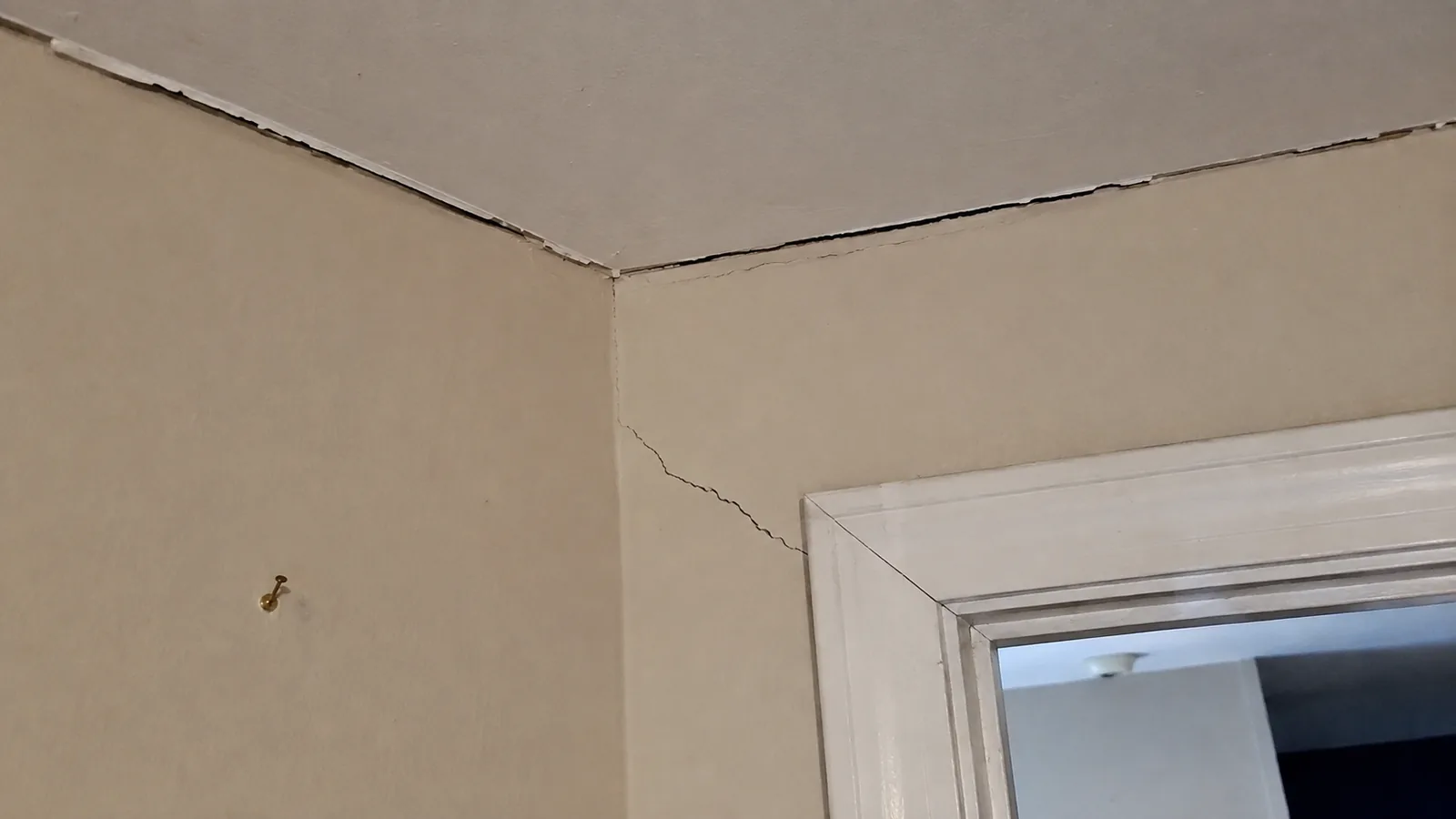
Drywall in Arvada cracks more than drywall in most of the country, and there are three reasons rather than one. Expansive clay soil moving under the foundation. Roof truss uplift moving the ceiling seasonally. And air dry enough to shrink the framing lumber away from its fasteners.
They produce different cracks in different places on different schedules, and telling them apart before you spend anything is the most useful thing on this page. Fixing a moving crack as though it were a static one guarantees you pay for it twice.
The three-question test
Answer these before you call anyone.
Where is it? A clean horizontal line where the ceiling meets an interior wall points at truss uplift. Diagonals from the corners of doors and windows, and cracks that continue through more than one room in the same direction, point at foundation movement. Small round pops in the middle of a wall, often in clusters along an outside wall, are fastener movement.
Does it change with the season? Truss uplift opens in winter and closes again in summer, reliably, year after year. That seasonal open-and-close is close to diagnostic. Soil movement is slower and less regular and tends to correlate with wet springs and with irrigation changes rather than with temperature.
Is anything else moving? Doors that bind at one corner, windows that stick, a gap opening between skirting and floor, or cracking in a basement slab or an exterior brick course all point away from drywall and toward the ground. If two or more of those are true, the crack is a symptom and the money belongs with a structural engineer before it belongs with us.
Expansive soil, which is a bigger deal than people realise
Arvada sits inside the Front Range Urban Corridor, and the Colorado Geological Survey's mapping of it is unambiguous. Half of the thirty sedimentary bedrock formations exposed in the corridor contain swelling clay, and those swelling formations underlie all of the major cities. The corridor holds more than 80 percent of Colorado's population.
The clay minerals involved, principally montmorillonite and bentonite, absorb water and expand. CGS puts the figures at up to 20 percent expansion by volume when wetted, exerting a force of up to 30,000 pounds per square foot. For scale on that force: it is far more than the weight of the house sitting on it.
CGS describes swelling clays as one of the most significant, widespread and costly but least publicised geologic hazards in Colorado, with annual losses regularly estimated as greater than tornadoes, floods, earthquakes and hurricanes combined. Their comparison is that one person in ten is affected by floods, and one in five by expansive soils.
The mechanism is counterintuitive: the problem is not that the ground is wet, it is that it is normally dry. Colorado's semi-arid climate primes the clay, and then it swells when it finally gets water, from a wet spring, from irrigation, from a downspout discharging next to the foundation, or from a slab leak. Which is why the cheapest thing most Arvada homeowners can do about interior cracking has nothing to do with drywall: get the downspouts discharging well away from the house and keep the irrigation off the foundation.
Colorado legislated about this, and your builder had to tell you
If you bought a new home in Colorado, a document about this exists and most people have never read it.
C.R.S. 6-6.5-101 requires that at least 14 days before closing on a new residence, the builder or developer gives the purchaser a copy of a summary report of the soil analysis and the site recommendations. Where the site has significant expansive soil potential, they must also supply a publication detailing the problems associated with such soils, the building methods used to address them during construction, and suggestions for care and maintenance. Failure to provide it carries a civil penalty of $500 payable to the purchaser.
So the state has legislated on the assumption that expansive soil is a foreseeable and normal condition of new residential construction here. If your house is newish and cracking, that report will tell you what the site was and what was done about it. Ask your builder or check your closing paperwork.
The law does not apply to someone building a home for their own occupancy.
Truss uplift, the seasonal one
This is the crack that most often gets misdiagnosed as foundation failure, and it is not structural at all.
A roof truss has its bottom chord buried in attic insulation while the rest of the truss sits out in cold, dry attic air. The two parts take up and give off moisture at different rates. The truss arches upward slightly at its centre, and in doing so it lifts the ceiling off the top plate of interior partition walls, the ones running perpendicular to the trusses and carrying no load.
What you see is a clean separation along the ceiling and wall junction. What you notice, if you watch it for a year, is that it opens in winter and closes in summer.
The fix is to stop fighting it. No fasteners into the truss bottom chord within about 24 inches of the wall, so the ceiling board is not pinned to a moving member. The ceiling drywall is tied to the wall drywall with truss uplift clips instead. In stubborn cases, a crown moulding fastened only to the wall lets the ceiling slide behind it invisibly. Better attic ventilation and moisture control reduces the movement at source.
What does not work is filling it. Rigid compound in a joint designed to move reopens by the following February, usually wider, and now there is a repaired-looking crack instead of a clean one.
Dry air and nail pops
Denver's relative humidity averages roughly 67 percent at 5am and about 34 percent at 2pm across the year, on NOAA normals, with annual precipitation of about 15.4 inches. Interior air with a furnace running through a Front Range winter is drier again.
Framing lumber gives up moisture and shrinks. The screws and nails do not move with it, so the board is pushed off the fastener head and a small circular pop appears. They arrive in clusters rather than singly, usually in the first few winters of a house's life and again after a significant change in heating or humidity.
This one is genuinely minor and genuinely easy to fix wrong. The repair that lasts is to drive a new screw an inch or two away into solid framing, then re-set or remove the popped fastener, then fill both and texture over. Filling the dimple alone puts compound over a fastener that is still moving and it will pop again through the new paint, usually within a year.
For completeness: the humidity-to-nail-pop link is standard building science rather than something with a Colorado-specific published study behind it, so treat the mechanism as well established and the local specificity as our reasoning rather than a citation.
So what do you actually do?
If it is seasonal and along a ceiling and wall junction, it is truss uplift, and it wants the corner detailing to float rather than a filler. That is a drywall job and it is ours.
If it is small round pops, it is fasteners. Drywall job, straightforward, and the right time to do it is when you are repainting anyway.
If it is diagonal from door and window corners, runs through more than one room, or comes with binding doors and slab or brick cracking, get a structural engineer to look before you spend anything on the drywall. We will say this to you on the phone and we will say it standing in the room. Repairing cracks over active movement is redecorating over a problem, and it is the fastest way to spend money twice.
And whatever the cause: fix the water first. Downspouts away from the foundation, irrigation off the perimeter, and no ponding at the wall. It is free and it addresses the largest of the three causes at its source.
| Cause | Where it shows | Timing | Right fix |
|---|---|---|---|
| Truss uplift | Clean line at ceiling and interior wall junction | Opens in winter, closes in summer | Float the corner, uplift clips, or crown moulding |
| Expansive soil movement | Diagonals from door and window corners, through multiple rooms | Wet springs, irrigation changes, slow | Water management first, structural opinion, drywall last |
| Framing shrinkage | Round pops in clusters, often on outside walls | First few winters, and after heating changes | New screw into solid framing, re-set the old, then fill |
| Poor original detailing | Cracks radiating from opening corners on one wall only | Any time, does not recur once fixed | Cut out, re-tape, blend |
Questions we get asked
Is a crack where my ceiling meets the wall structural?
Usually not. A clean horizontal separation at the ceiling and interior wall junction that opens in winter and closes in summer is truss uplift, a seasonal movement caused by the truss bottom chord and the rest of the truss drying at different rates. It is a finish problem rather than a structural one.
Why do so many Colorado houses crack?
Expansive clay soil. The Colorado Geological Survey maps swelling clay in half of the thirty sedimentary bedrock formations exposed in the Front Range Urban Corridor, and those formations underlie all the major cities. The clay can expand up to 20 percent by volume when wetted and exert up to 30,000 pounds per square foot.
Should I fill a crack myself?
If it is small, static and not seasonal, yes, and a setting compound with paper tape will outlast a tube of filler. If it reopens every winter, filling it makes it worse each time. If it comes with binding doors or cracking elsewhere, do not fill it, get it looked at.
When do I need a structural engineer rather than a drywall contractor?
When cracks run diagonally from the corners of openings, when they continue through more than one room in the same direction, or when doors bind, windows stick, or you can see cracking in the slab or in exterior masonry. Two or more of those together, get the engineer first.
Will fixing the crack stop it coming back?
Only if the fix matches the cause. A truss uplift crack detailed to float will stay closed. The same crack filled with rigid compound will reopen by the next winter. A crack over active soil movement will reopen whatever you do to it until the movement is addressed.
Related
- Ceiling Repair · Sagging, cracked or holed ceilings put back and re-textured to match.
- Texture Matching · Knockdown, orange peel and skip trowel blended into what is already on your wall.
- Popcorn Ceiling Removal · Scraped, skimmed and re-textured, with the asbestos rule explained before we quote.
- Everywhere we work