Water Damage Drywall Repair in Arvada, CO
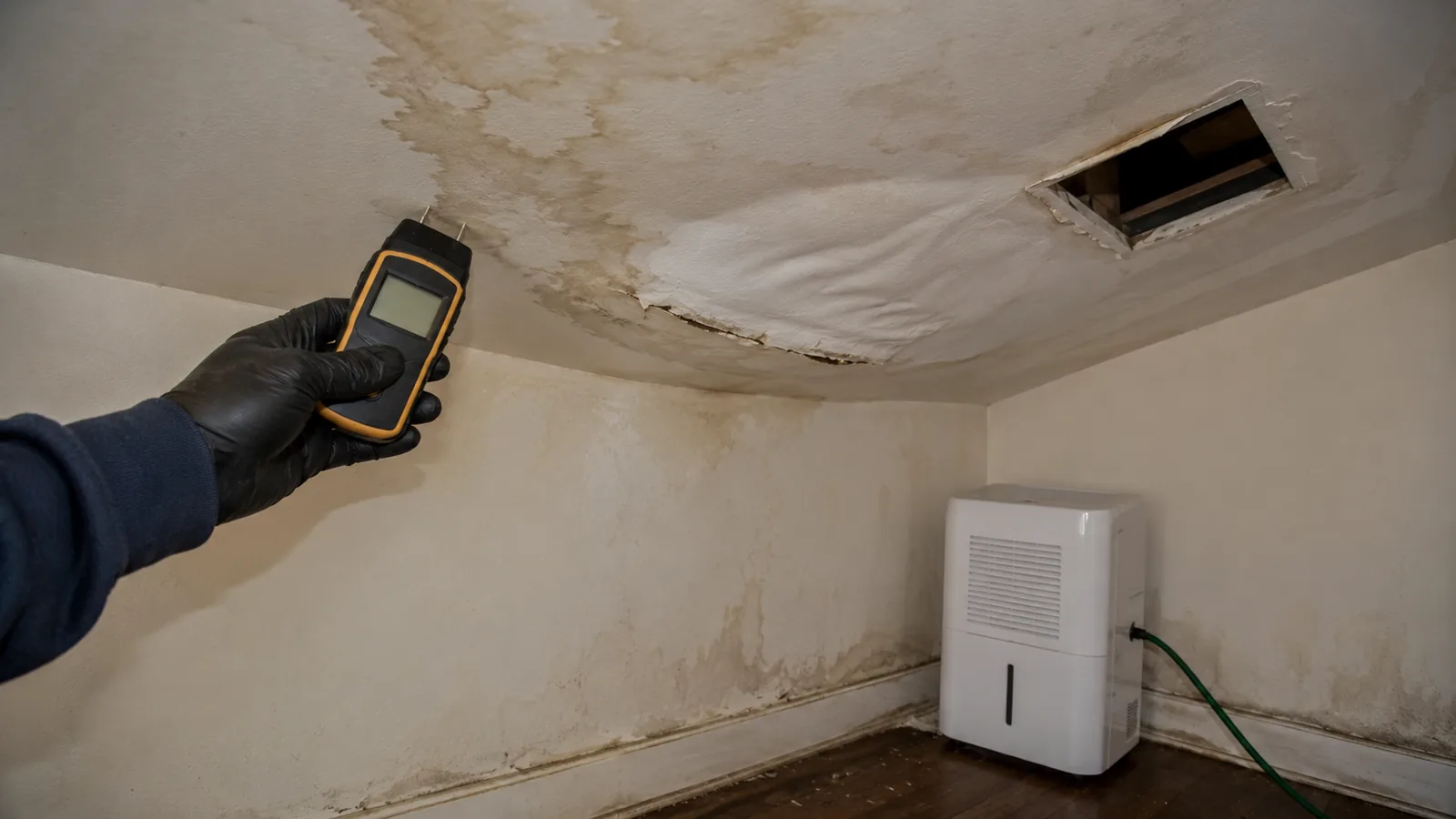
Water damaged drywall repair in the Denver metro runs $635 to $1,640, and the number is driven almost entirely by how far the water travelled rather than by how big the stain looks. Water runs along the bottom of a top plate and drops somewhere else. The visible mark is where it pooled, not where it went.
This is a separate page from ordinary drywall repair for a reason. The buyer is usually in a different situation, the sequence is different, there is often an insurer involved, and the failure mode is not a bad patch but mould behind a good one.
What we do before we cut anything
We map it with a moisture meter first. Pin readings into the board and into the framing at the opening, plus a non-invasive scan outward from the stain until readings come back to the same as an unaffected wall in the same room. That perimeter, not the stain, is what gets opened.
Then we take photographs with the meter reading visible in frame. If there is an insurance claim, that is the documentation the adjuster will ask for, and it is far easier to take at the start than to reconstruct afterwards. We hand it over whether or not you end up claiming.
Then we stop. If the framing is wet, board does not go back on until it is dry, and in a Denver August that might be two days with a fan and in a February with a slab leak it might be a week. Nobody enjoys this part. It is still the whole job.
Why wet framing behind new board is the expensive mistake
Gypsum board is paper on both faces and paper is food. Seal wet wood behind new board, in a cavity with no airflow, and you have built a small incubator. What comes back is not a drywall problem any more, it is a remediation problem, and the cost gap between the two is an order of magnitude.
It also comes back visually. A stain on framing that is still holding moisture will wick into new board and bleed through paint, sometimes months later, and everyone blames the paint.
If the material has to come out, mould-resistant board is worth the small premium in the wet areas. USG's Mold Tough and Gold Bond's XP with its purple face paper both score at the top of the ASTM D3273 mould test. It is not magic, it is paper that is harder to eat, and in a bathroom ceiling that has already failed once it is a sensible upgrade for a few dollars a sheet.
Is water damaged drywall always replaced?
No. A ceiling that is stained but dry, sound and not sagging is a sealing and painting job, not a drywall job. We meter it, and if it reads dry and the board still holds a screw and does not deflect under a hand, we will say so and quote you the smaller job.
Board comes out when it is soft, when it is sagging, when the paper face has delaminated, when the seams have opened, or when the moisture reading will not come down after drying. That last one usually means the leak is still live somewhere.
The place people are most often talked into replacement they do not need is a small brown ring under an upstairs bathroom, where the leak was a one-time overflow rather than a plumbing failure. Half a day, a stain-blocking primer and a coat of ceiling paint fixes it properly.
Bathrooms, showers and what board belongs where
This is the part that gets built wrong most often, and it is worth knowing before you accept a quote. Ordinary water-resistant gypsum, the green board people ask for by name, is not an approved tile backer in a shower or tub surround. The IRC lists the approved options by standard: glass-mat gypsum to ASTM C1178, fibre-reinforced gypsum to C1278, non-asbestos fibre-cement to C1288, and fibre-mat reinforced cementitious backer units to C1325, which is the category cement board like Durock sits in.
The code also says water-resistant backing must not be installed over a Class I or II vapour retarder in a shower or tub compartment, and that cut edges are sealed per the manufacturer.
PABCO put the extreme end more bluntly than the code does: in saunas, steam rooms, gang showers or indoor pools, gypsum panels are not to be used for any reason. If your last shower failed at the bottom of the wall, there is a decent chance the wrong board was behind the tile.
| Situation | Typical range | What decides it |
|---|---|---|
| Water damage drywall repair, Denver | $635 to $1,640 | Distance the water travelled |
| Ceiling water damage | $600 to $1,550 | Whether insulation came down with it |
| Dry stained ceiling, seal and paint only | Well under the above | Meter reads dry, board still sound |
| Repair where framing must dry first | Add 2 to 7 days | Not cost, but schedule, and it is not optional |
| Mould-resistant board upgrade | A few dollars a sheet | Worth it in a bathroom that has failed once |
Questions we get asked
How long before you can close the wall back up?
Until the framing meters dry, which is usually two to four days with airflow in Denver's climate and longer if the source was a slow leak into an enclosed cavity. We will not guess it, we will measure it, and we will show you the reading.
Do you work with insurance?
We are not a restoration contractor and we do not bill insurers directly, but we photograph everything with moisture readings visible and give you an itemised scope that adjusters accept. If the loss is large or category three water, you want a restoration firm first and us afterwards.
Is a small brown ring on the ceiling worth worrying about?
Only if it is still growing or the board is soft. A dry, stable, hard stain from a one-time overflow is a primer and paint job. We will meter it for you and tell you which one you have.
Can you find the leak?
Sometimes, because opening the ceiling often shows you exactly where the water was tracking. But we are drywall contractors, not plumbers or roofers, and if the source is not obvious once it is open we will tell you to get the right trade in before we put board back.
Related
- Ceiling Repair · Sagging, cracked or holed ceilings put back and re-textured to match.
- Texture Matching · Knockdown, orange peel and skip trowel blended into what is already on your wall.
- Popcorn Ceiling Removal · Scraped, skimmed and re-textured, with the asbestos rule explained before we quote.
- Everywhere we work