Soundproofing Drywall in Arvada, CO
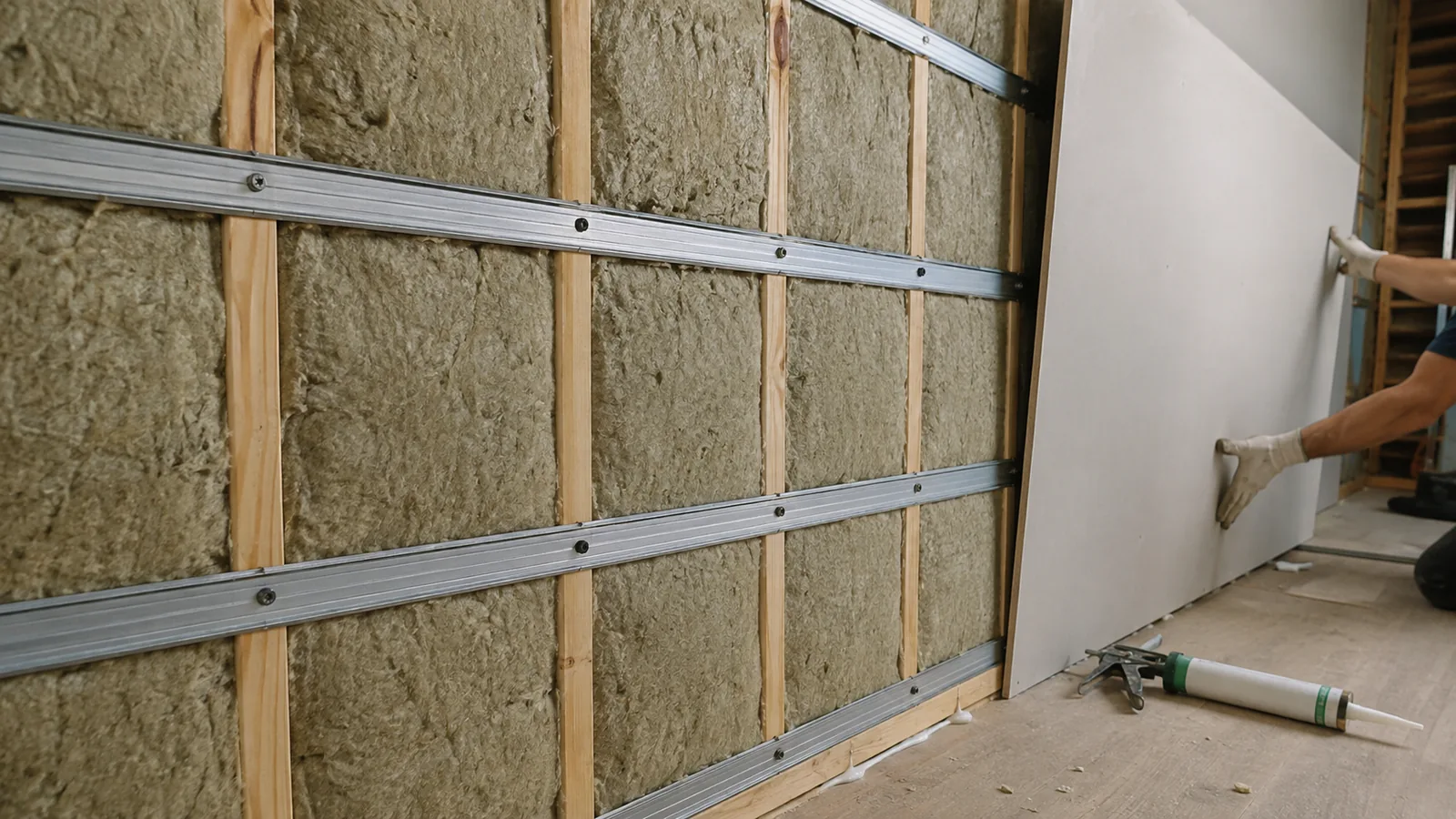
Adding one extra layer of damped gypsum panel can raise a wall's STC rating by up to 11 points, and decoupling strategies like resilient channel or isolation clips add 5 to 14. Both of those figures are National Gypsum's, and both come with a caveat they publish themselves and almost nobody repeats: wall assemblies with the same STC rating are not always equal in performance.
That caveat is the reason this page exists. Soundproofing gets sold as a product when it is actually an assembly, and the money goes in the wrong place more often than not.
The four things that actually work, in order of value per dollar
Mass. Heavier assemblies transmit less. Two layers of five-eighths beats one layer of anything, and it is the cheapest point on the curve.
Decoupling. Break the mechanical path so the wall cannot act as one drum skin. Resilient channel, sound isolation clips with hat channel, a staggered stud wall, or a full double stud wall. This is where the 5 to 14 point range comes from and it is the biggest single lever.
Absorption in the cavity. Mineral wool batts, not fibreglass if you have the choice, filling but not compressed. Compressed insulation loses much of the benefit.
Damping. This is what QuietRock and similar constrained-layer panels do: a thin layer of steel and a viscoelastic core inside the board that turns vibration into heat. QuietRock 530 is a five-eighths panel at 2.88 pounds per square foot, one hour fire rated to ASTM E119, Class A flame spread, in assemblies tested from STC 48 up to STC 74 for a double 2x4 wood stud wall with double-layer panel both sides.
Do them in that order. A damped panel screwed rigidly to a stud wall with an empty cavity is the most expensive way to get a small improvement, and it is what gets sold.
Where sound is actually getting through
Before spending anything on the wall, check the paths around it. A wall built to STC 55 with an undercut door, a back-to-back electrical box, a shared duct or an unsealed top plate performs like a much worse wall, because sound behaves like water and finds the gap.
The order we check: doors first, then penetrations, then flanking through floor and ceiling, then the wall itself. Acoustic sealant around the perimeter of every layer is not optional and it is the cheapest part of the job. Boxes on opposite sides of a wall get offset by at least one stud bay.
We have walked away from two of these in the last year where the honest answer was that a solid-core door and a threshold seal would fix it for a couple of hundred dollars. That is not generosity, it is that a soundproofing job that does not work is a job you get called back to.
What STC numbers actually mean to you
STC is a single number derived from a laboratory transmission-loss test under ASTM E90 and classified under ASTM E413. It weights speech frequencies. It does not weight bass, which is why a home theatre or a drum kit will punch through a wall that tests fine for conversation.
For a practical read: a standard single-stud wall with board both sides lands around STC 33 to 38, which is loud speech audible. A one-hour UL U305 wall, 2x6 studs at 16 inches on centre with five-eighths Type X both sides and glass fibre insulation, is STC 38. UL U301, the two-hour assembly with double layers both sides and one side on resilient channel, is STC 58. That difference, 38 to 58, is the whole story of what decoupling and mass do together.
Above about STC 60 in a retrofit you are usually into double stud walls and floating floors, and the cost curve goes vertical. We will tell you where on that curve your budget lands before you commit to anything.
Retrofitting an existing wall without opening it
The most common request we get is soundproofing a wall that is already finished, without gutting it. It is possible and it is a compromise.
Adding a second layer of five-eighths over the existing board, with a damping compound between the layers, gets a meaningful improvement for a day of work plus retrim of the outlets and the door casing. You do not get the decoupling benefit because the existing board is still rigidly attached, so expect the mass and damping contribution rather than the whole assembly figure.
Adding resilient channel over existing board and then a new layer is worse than it sounds. Channel over a rigid layer does not decouple much, and it costs you an inch and a half of room. If decoupling matters that much, the wall comes off.
| Measure | Typical contribution | Note |
|---|---|---|
| UL U305, 2x6 at 16 in oc, 5/8 Type X both sides, insulated | STC 38 | One hour fire rated |
| UL U301, double layer both sides, one side on resilient channel | STC 58 | Two hour fire rated |
| Decoupling: resilient channel, clips, staggered or double stud | adds 5 to 14 points | Biggest single lever |
| One extra layer of damped panel | adds up to 11 points | Mass plus damping |
| QuietRock 530 assemblies as tested | STC 48 to 74 | 5/8 in, 2.88 lb per sq ft, one hour rated |
| Acoustic sealant at every perimeter | Small number, large effect | Skipping it undoes the rest |
Questions we get asked
Does soundproof drywall actually work?
Damped panels like QuietRock work, and National Gypsum puts one extra layer of their equivalent at up to 11 STC points. They work best as one part of an assembly with mass, decoupling and cavity insulation. A damped panel screwed rigidly to an empty stud wall is the most expensive way to get the least improvement.
Is QuietRock worth it over two layers of ordinary 5/8?
It depends on whether you can afford the wall thickness. Two layers of five-eighths with damping compound between them gets you close for less money and costs you an extra half inch. QuietRock gets you there in one panel, which matters in a small room or where trim and door jambs are already set.
Can you soundproof a wall without tearing it out?
Partly. A second layer over the existing board with damping compound between gets you the mass and damping benefit in about a day. You cannot get the decoupling benefit without opening the wall, and decoupling is the biggest single contributor, so set expectations accordingly.
What STC do I need?
For speech privacy between bedrooms, high 40s to low 50s is usually enough. For a media room with real bass, STC misses the point because it weights speech frequencies, and you should be talking about mass and decoupling rather than a target number.
Related
- Ceiling Repair · Sagging, cracked or holed ceilings put back and re-textured to match.
- Texture Matching · Knockdown, orange peel and skip trowel blended into what is already on your wall.
- Popcorn Ceiling Removal · Scraped, skimmed and re-textured, with the asbestos rule explained before we quote.
- Everywhere we work