How to Identify the Drywall Texture on Your Wall
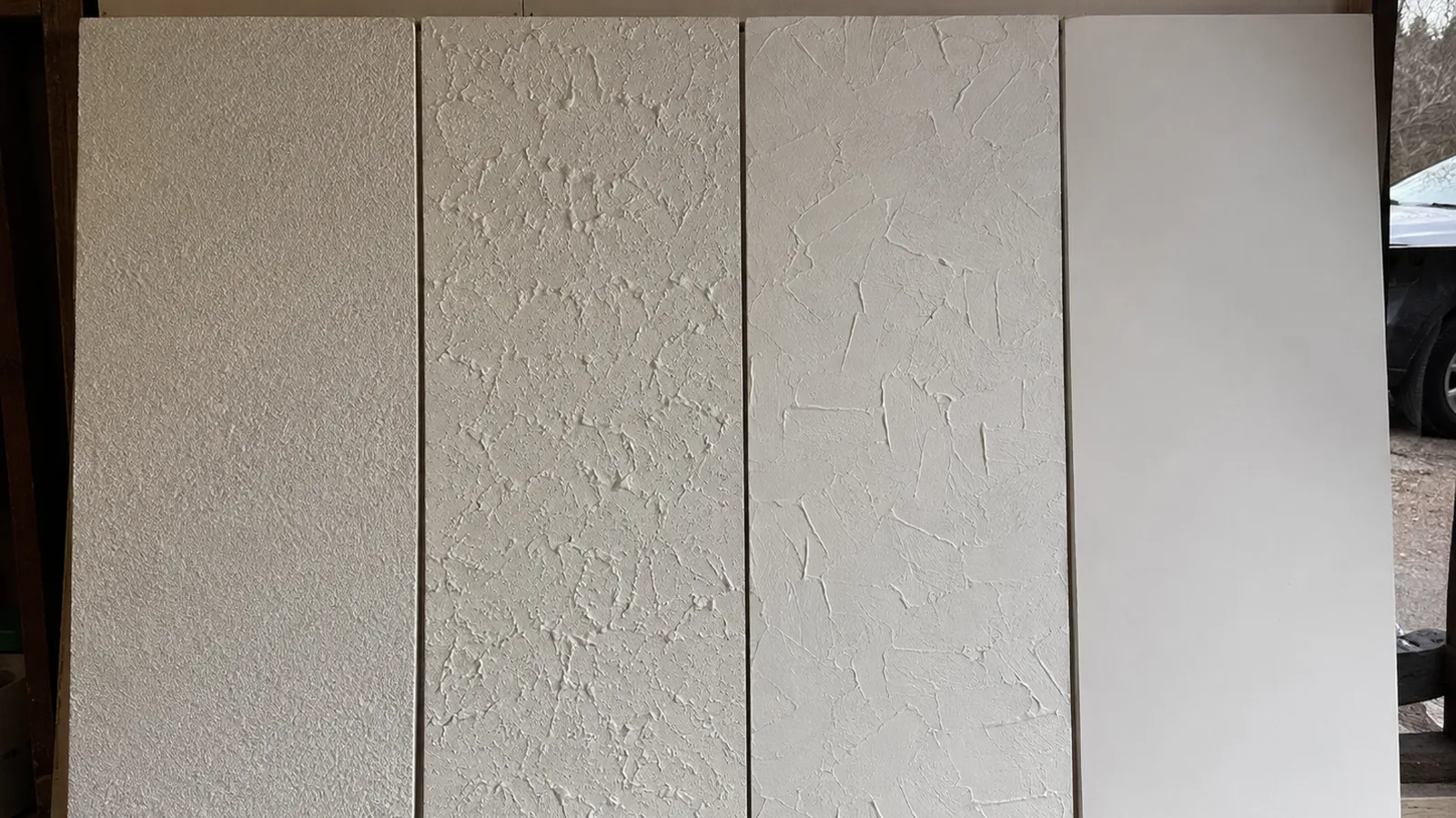
You can identify almost any wall texture with a torch, a hand and about thirty seconds. Hold a torch flat against the wall so the beam skims across it rather than hitting it straight on. That is what the trade calls raking light, and it is the whole trick: texture disappears under a light shining directly at it and shows up completely under a light shining across it.
Then run your hand over it. Texture is either sprayed or trowelled, and your palm can tell the difference immediately. Sprayed textures feel granular and even. Trowelled textures have flat plateaus with edges between them.
Orange peel
Looks like the skin of an orange. Fine, even, all-over bumps with no flat areas and no directional pattern. Feels slightly rough like fine sandpaper but with no edges you could catch a fingernail on.
It is sprayed. Atomised joint compound thrown at the wall at roughly 40 psi of atomising air with material fed at around 20 psi, per USG's own figures, and left exactly as it lands.
For repairs this is the friendliest texture there is. The variables are forgiving, a blend edge disappears easily, and a competent patch will genuinely be invisible. Installed cost runs about $0.80 to $1.50 per square foot.
In the field people sometimes call this splatter, though the manufacturers treat spatter as a separate coarser pattern sprayed at different settings. If your contractor uses the words interchangeably that is normal trade usage rather than a mistake.
Knockdown
Looks like flattened splatter: irregular flat islands with slightly raised edges, separated by smoother low ground. Often described as looking like stucco that someone has ironed. Under raking light you see clear flat plateaus rather than even bumps.
It is sprayed then bladed. The compound goes on at spatter settings, roughly 60 psi atomising with material at about half that, and once it has tacked off for a few minutes a wide blade is drawn across it to flatten the peaks. How long you wait before knocking it down is what changes the look, which is precisely why matching it is harder than matching orange peel.
This is the most common wall texture in this part of Colorado in our experience, and the one we test on a board for every single time. Installed cost $1.00 to $2.50 per square foot.
Matching notes: good on walls, variable on ceilings, because a ceiling gets raking light along its whole length and a wall usually does not.
Skip trowel and hand-applied textures
Looks like knockdown but more irregular, with longer sweeping flat areas and visible directionality. If you can see the arc of somebody's arm in the pattern, it is hand-applied.
It is trowelled, not sprayed. Compound is applied thin and skipped across the surface with a curved blade, leaving flat areas and gaps.
For repairs this is the honest one: matching it is a question of whether we can copy the original hand, not of getting a machine setting right. Sometimes yes, on a small area, in a corner. On a large wall in good light, the better answer is often to re-texture the whole wall rather than chase the patch, and we would rather say that at the quote than after.
Note on terminology: skip trowel is manufacturer-documented vocabulary. Santa Fe, stomp, slap brush and sand swirl are all real terms tradespeople use, and we use them too, but they do not appear in manufacturer or standards documentation, so different contractors will mean slightly different things by them. If you are describing your texture on the phone, a photo beats a name.
Popcorn, also called acoustic
Unmistakable. Heavy, lumpy, cottage-cheese texture, ceilings only, usually white and usually slightly grey with age. Crumbles if you rub it.
It is sprayed as a thick aggregate-loaded material. It was used for acoustic damping and, more honestly, for hiding a ceiling finished to a level 2 or 3.
Two things you need to know before touching it. First, patching it above a couple of square feet almost never looks right, especially where the ceiling has been painted since. Second, and this is the important one, in Colorado if you are disturbing more than 32 square feet of it you are legally required to have it tested for asbestos first by a certified inspector, and the only age exemption is construction after 12 October 1988 with documentation.
The median Arvada home was built in 1979.
Smooth, and why it is not the absence of texture
A smooth wall is a finish level rather than an untextured wall, and it is more work than texture rather than less. That surprises people.
GA-214-2021 level 5 is a level 4 plus a thin skim coat of joint compound over the entire surface. The skim exists because texture hides imperfection and smooth does not: without it, the difference in porosity and profile between the finished joints and the board face shows through the paint.
One Colorado homeowner building a custom house put it neatly on Houzz, noting that smooth walls cost roughly twice as much here as texture, where on the East Coast smooth is the default. That is a real regional difference and it is why so much Front Range housing is textured.
Smooth is worth it under gloss or satin paint, under a deep colour, and on any wall that gets strong side light from a window. GA-214 defines those triggers precisely: non-flat paint means more than 5 gloss units at 60 degrees or 10 at 85, and critical lighting means strong side lighting from windows or surface-mounted fixtures.
Why your texture repair will not match, even done well
Four variables have to line up and only one of them is written down anywhere: mud consistency, nozzle size, air pressure, and the speed and distance of the pass. USG's own guidance for spray texture is to adjust the air spike, orifice and pressure to optimise atomisation, with slight adjustments for the type and grade of aggregate. When the manufacturer declines to publish a number, there is no number.
There is a fifth variable nobody can undo. Every coat of paint since the texture went on has softened its profile, so a technically correct fresh patch comes out sharper than forty-year-old texture beside it. That is our working theory from doing the job rather than something published, but it explains why matching gets harder with the age of the house.
The two things that actually make a match work: testing on a board first and adjusting before anything touches the wall, and blending outward well past the repair so there is no hard edge for the eye to catch. Neither is expensive. Both get skipped.
| Texture | How it looks under raking light | How it feels | Applied | Cost per sq ft | Match difficulty |
|---|---|---|---|---|---|
| Orange peel | Fine even bumps, no flat areas | Like coarse sandpaper | Sprayed, ~40 psi | $0.80 to $1.50 | Easy |
| Knockdown | Flat islands with raised edges | Flat plateaus with ridges | Sprayed then bladed | $1.00 to $2.50 | Moderate |
| Skip trowel | Long sweeping flat areas, directional | Flat, with edges you can feel | Hand trowelled | $1.00 to $2.50 | Hard |
| Popcorn / acoustic | Heavy lumps, ceilings only | Crumbles if rubbed | Sprayed thick | $1.00 to $2.00 | Do not patch above 2 sq ft |
| Smooth / level 5 | Nothing, that is the point | Flat | Skim coat over level 4 | $2.00 to $3.50 | Whole wall, not a patch |
Questions we get asked
How do I tell orange peel from knockdown?
Shine a torch across the wall rather than at it. Orange peel is fine even bumps with no flat areas anywhere. Knockdown has clearly visible flat islands with slightly raised edges around them. If your hand catches on edges, it is knockdown.
What is the most common wall texture in Colorado?
In the Arvada and Jefferson County homes we work in, knockdown and orange peel are what we see most, with popcorn on ceilings in anything built before the mid-eighties. That is our field observation across this patch rather than a published statistic, because no survey of regional texture prevalence exists.
Can a texture be matched exactly?
Orange peel, usually yes, to the point you will not find it. Knockdown, yes on a wall and variably on a ceiling. Hand-applied textures depend on the pattern. Popcorn above about two square feet, honestly no, and anyone promising otherwise has not done many.
Do I have to texture a wall at all?
No. A smooth level 5 finish is a legitimate choice and in much of the country it is the default. In Colorado it costs meaningfully more than texture, roughly double according to homeowners who have priced both, because it is a full skim coat rather than a spray pass.
Is popcorn ceiling texture dangerous?
Undisturbed and intact, it is generally left alone. Disturbed, it is a legal question in Colorado: above 32 square feet you must have it inspected by a certified inspector before the work starts, and you cannot tell by looking whether it contains asbestos.
Related
- Ceiling Repair · Sagging, cracked or holed ceilings put back and re-textured to match.
- Texture Matching · Knockdown, orange peel and skip trowel blended into what is already on your wall.
- Popcorn Ceiling Removal · Scraped, skimmed and re-textured, with the asbestos rule explained before we quote.
- Everywhere we work