Popcorn Ceiling Removal in Arvada, CO
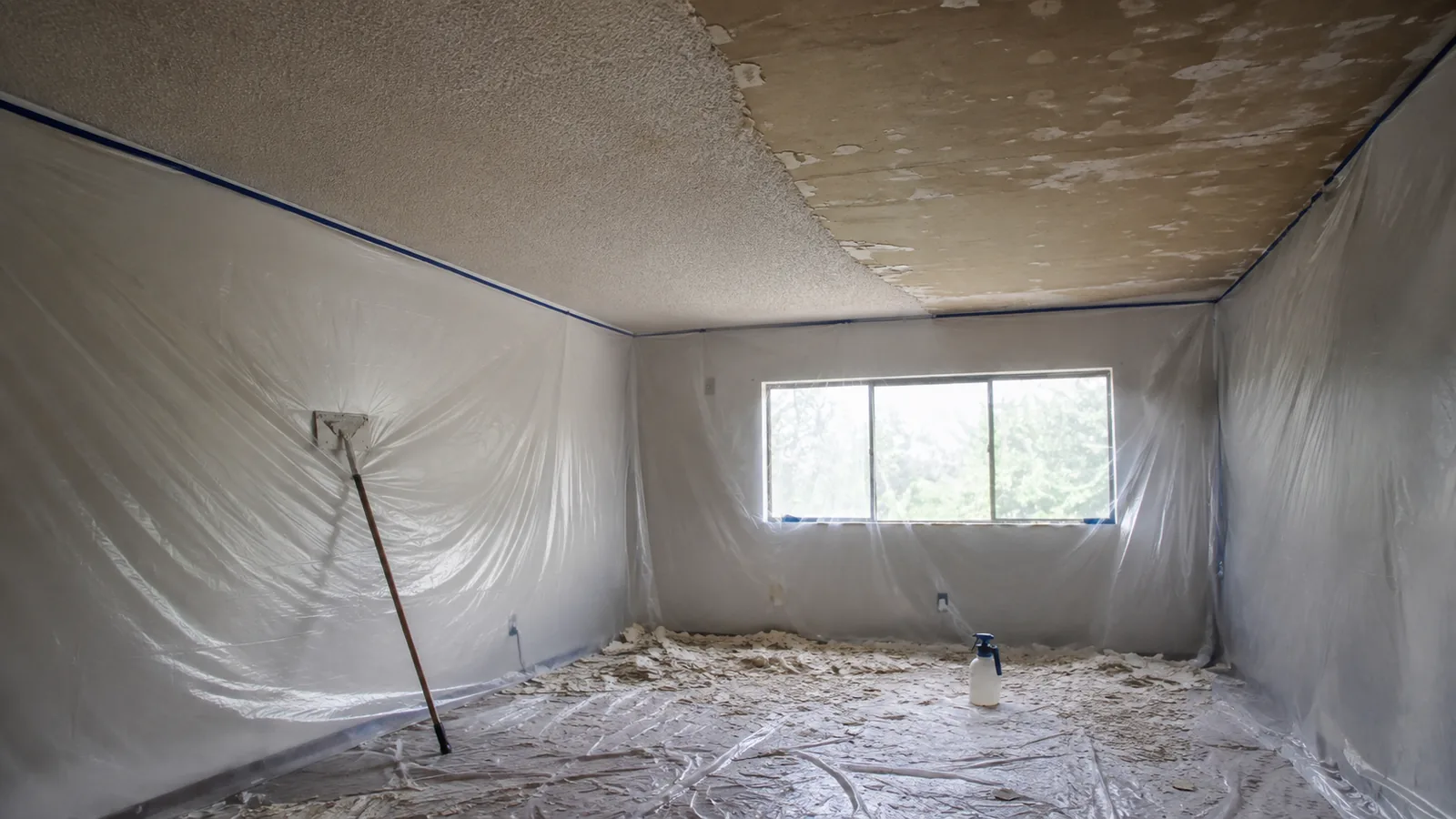
Popcorn ceiling removal in the Denver metro runs about $1 to $3 per square foot, so roughly $2,000 to $2,500 on a 1,000 square foot main floor. If the texture tests positive for asbestos, abatement runs $4 to $8 per square foot on top, which adds $2,000 to $4,000 to that same ceiling.
Before any of that: in Colorado you are legally required to have the material tested if the job disturbs more than 32 square feet. That is about a six foot by six foot patch of ceiling. Almost every popcorn removal in Arvada is over that line, and half the homes in this city were built before 1980.
The 32 square foot rule, in plain terms
Colorado Regulation 8 Part B sets the trigger for a single-family residential dwelling at 50 linear feet on pipes, 32 square feet on other surfaces, or the volume equivalent of a 55-gallon drum. Above that, the material has to be inspected before it is disturbed, and the inspection has to be done by a Colorado-certified building inspector working for a registered asbestos consulting firm. Samples go to an NVLAP-accredited laboratory.
The sampling count is set too. For surfacing material, a homogeneous area up to 1,000 square feet takes a minimum of three samples, 1,000 to 5,000 square feet takes five, and above 5,000 takes seven. That is where the three-five-seven shorthand comes from.
Two details that get missed. First, the rule is not only about popcorn. Regulation 8 explicitly allows drywall and its associated joint compound to be composited for sampling, but requires that surfacing materials added to drywall be sampled separately, which means wall and ceiling texture gets its own samples. Second, the only age exemption is a building constructed after 12 October 1988 with documentation confirming no asbestos-containing materials were used. Not 1978. 1988.
A DIY test kit off a shelf does not satisfy the requirement where a permit is involved. If someone quotes you a popcorn removal on a 1,400 square foot ranch without mentioning testing, that is the single clearest sign in this trade that you are talking to the wrong outfit.
Why was asbestos in it, and until when?
Two separate federal actions matter here and they are often merged into one. The Consumer Product Safety Commission banned asbestos in consumer patching compounds, which explicitly included drywall spackling and tape joint compounds, in a rule published 15 December 1977. Products manufactured or introduced into commerce after 16 January 1978 were banned, and everything else after 11 June 1978. The CPSC estimated at the time that roughly half of 1977 patching compound sales contained asbestos.
Spray-applied texture came under the EPA instead. EPA banned spray-applied surfacing material for fireproofing and insulating purposes in 1973, and in 1978 banned spray-applied surfacing materials for purposes not already covered, which is the provision that reaches decorative and acoustic ceiling texture.
So the honest summary is: late seventies for both, by different agencies, and Colorado's regulatory line is 1988 regardless. Arvada's median home was built in 1979.
What the removal actually involves
Assuming a clean test, removal is a wet-scrape job. The ceiling gets misted with a garden sprayer, left to soak for a few minutes, and scraped with a wide blade into a covered floor. Everything below gets plastic, and the plastic goes floor to ceiling on the walls, not just over the furniture. Registers get sealed.
That last part is the whole job as far as your house is concerned. The complaint that turns up over and over in homeowner threads is not a bad ceiling, it is dust. One homeowner described a contractor sanding a three by five foot popcorn ceiling and sending a plume of white dust through the whole house via the ductwork, twice, contaminating carpet, furniture, clothing and bedding. That is entirely avoidable and it is avoided by taping the registers and wet-scraping rather than dry-sanding.
After the scrape the lid is almost never ready to paint. Scraping exposes the original tape joints and screw dimples, which were finished to a level 2 or 3 because nobody expected them to be seen. So there is a skim, a sand, and then either a new texture or a smooth level 5 finish. Budget for that stage. It is the part that gets left off cheap quotes.
Should you scrape it or cover it?
Covering a popcorn ceiling with new quarter-inch board is a real option and occasionally the better one, particularly where the texture tested positive and full abatement would cost more than the rest of the job combined. Encapsulating rather than removing is generally allowed where the material is left undisturbed, though the moment you are screwing through it you are disturbing it, so this is a conversation to have with the abatement contractor rather than with us.
Where the test comes back clean, scraping wins on almost every count: no lost ceiling height, no added weight on the framing, no new layer of joints to finish. The one case for covering a clean ceiling is a lid that is already sagging or has been painted over, because painted popcorn does not wet through and scraping it becomes a genuinely miserable, and expensive, job.
Painted popcorn is worth pricing before you commit. It roughly doubles the scrape labour, and there is no trick that gets around it.
| Item | Cost | Scope |
|---|---|---|
| Removal, Denver metro | $1 to $3 per sq ft | Scrape and clean up |
| 1,000 sq ft ceiling, Denver | $2,000 to $2,500 | Typical main floor |
| Removal with retexture and paint | $2 to $6 per sq ft | The realistic all-in number |
| Asbestos sample, per sample | $50 to $150 | Three samples minimum under 1,000 sq ft |
| Reg-8 compliant inspection, single material | $350 to $500 | What most single-ceiling jobs need |
| Full pre-demolition survey | $1,700 to $2,500+ | Whole-house renovation scope |
| Abatement if positive, Denver | $4 to $8 per sq ft | Adds $2,000 to $4,000 on 1,000 sq ft |
Questions we get asked
Does my popcorn ceiling need asbestos testing in Colorado?
If the work will disturb more than 32 square feet of it, yes. Colorado Regulation 8 Part B sets that trigger for single-family homes, and the only exemption is a building constructed after 12 October 1988 with documentation that no asbestos-containing materials were used. Most Arvada popcorn removals are well over 32 square feet.
Can you tell by looking whether it has asbestos?
No, and nobody can. Asbestos fibres in ceiling texture are not visible and the material looks identical either way. Age narrows the odds but does not answer it, which is exactly why the state requires laboratory analysis by an NVLAP-accredited lab rather than a judgement call.
Do you do the testing yourselves?
No. Sampling has to be done by a Colorado-certified building inspector working for a registered asbestos consulting firm, and we are neither. We will give you two or three local firms to call and we will not take the job until the result is in your hand.
How long does a popcorn removal take?
About a day and a half for a typical main floor if the ceiling is unpainted, plus a return visit for the skim, sand and retexture. Painted popcorn roughly doubles the scrape time because the water cannot get into the texture.
Will removing it increase my home value?
It is one of the more reliably requested changes in this housing stock, and in a city where the median home was built in 1979 it is a common ask from buyers. We are drywall contractors rather than agents, so treat that as an observation from the jobs we get called to rather than a valuation.
Related
- Ceiling Repair · Sagging, cracked or holed ceilings put back and re-textured to match.
- Texture Matching · Knockdown, orange peel and skip trowel blended into what is already on your wall.
- Water Damage Repair · Wet board out, framing dried and metered, then rebuilt and re-textured.
- Everywhere we work