Drywall Ceiling Repair in Arvada, CO
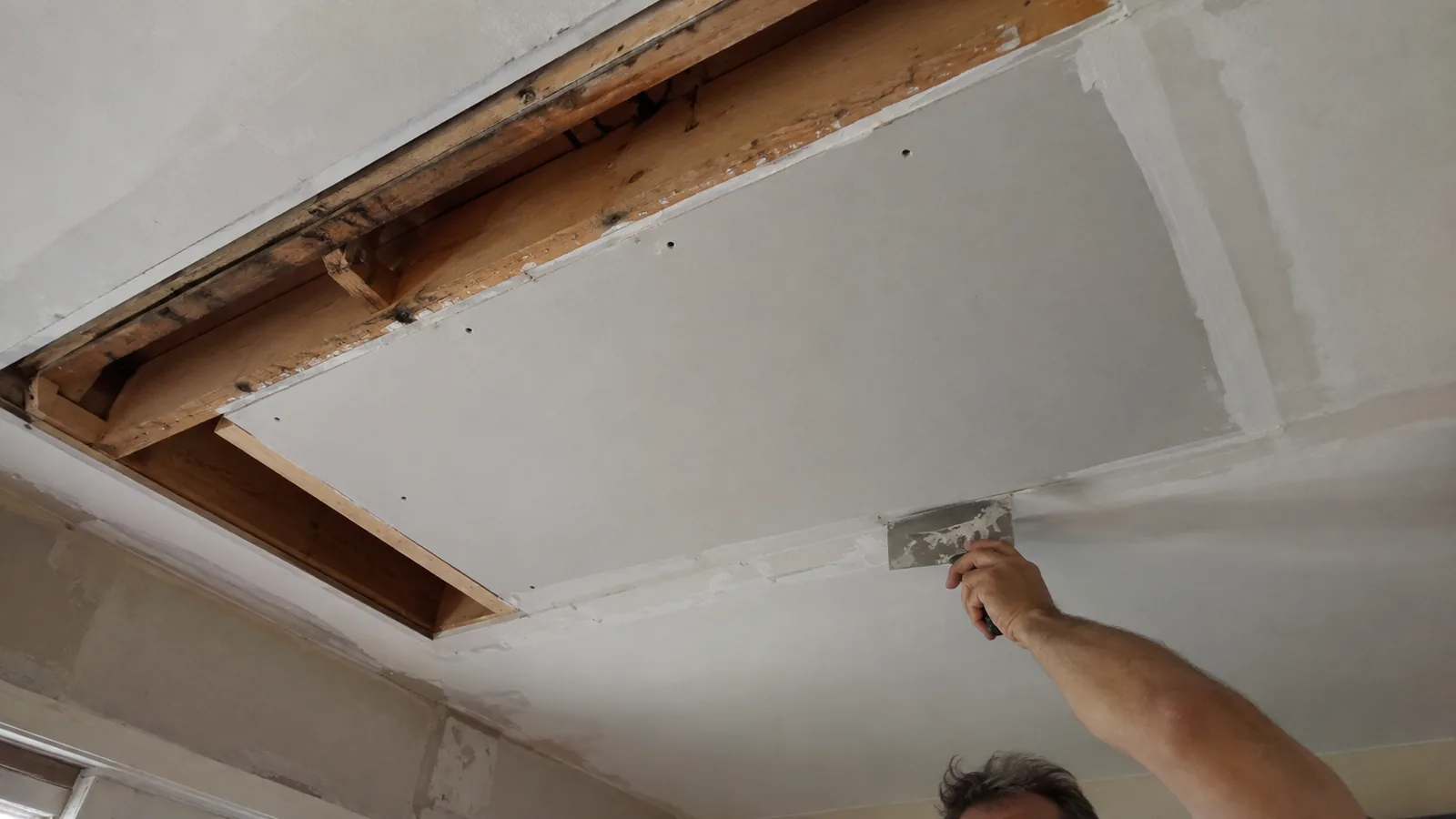
Ceiling drywall repair in Arvada runs between $235 and $1,380 depending on the size of the opening and the texture overhead. Ceilings cost more than walls for the same square footage, generally 20 to 40 percent more, and the reason is gravity rather than greed: everything has to be held up while it is fastened, sanded overhead, and textured against a surface you cannot get a raking light across easily.
Most of the ceiling calls we get in Arvada are one of four things. A brown ring from a bathroom above. A seam that has opened in a straight line across the room. A foot going through a garage ceiling from the storage above it. Or a lid that has started to belly downward between the joists, which is nearly always a board thickness problem rather than a water problem.
Why is my ceiling sagging between the joists?
A ceiling sagging in even scallops between joists is almost always half-inch board on framing spaced 24 inches on centre, finished with a sprayed water-based texture. That combination is not permitted, and it has not been for a long time. The IRC ceiling table steps the minimum thickness up from three-eighths to half-inch at 16 inches on centre, and from half-inch to five-eighths at 24 inches on centre, with a footnote that three-eighths board is not to be used on a ceiling receiving a water-based texture at all.
The reason is that spray texture is water, and water is weight. The board absorbs it, softens, and takes a permanent set between its supports. Once it has done that, no amount of screwing it back up will bring it flat, because the paper face has already stretched.
There are three fixes that actually hold. Five-eighths board. A half-inch panel specifically listed as sag-resistant ceiling board, which is a different product from ordinary half-inch and is evaluated against ICC-ES AC417 for exactly this application. Or a second layer. We will tell you which one your ceiling needs before we quote it, and if the answer is that only the one bay is affected, we will say that too.
Water stains, and the four days nobody wants to hear about
Here is the part people push back on. If a ceiling is stained from a leak, we will not close it up the same week unless a moisture meter says the framing above is dry. Pin-testing the joists through the opening takes two minutes and it is the difference between a repair and the same repair again in March.
Closing wet framing behind new board is how you get a stain that bleeds back through two coats of paint, and how you get a mould claim that was not there before. The stain will come through anyway if the board is not sealed, which is why the primer coat on a water-stained ceiling is a shellac or a sealing primer rather than the wall paint, and why Zinsser Gardz goes onto torn or softened facing paper before any compound touches it. Gardz soaks in and hardens crumbling paper so a skim coat has something sound to bond to instead of bubbling off it.
If your ceiling is actively dripping, the drywall is the last thing to worry about. Find the shutoff, then call us.
Cracks that run the length of the room
A clean horizontal crack where the ceiling meets the wall, that opens in winter and closes again in summer, is usually truss uplift and not settlement. The bottom chord of a roof truss sits buried in attic insulation while the rest of the truss is out in cold attic air. The two dry at different rates, the truss arches upward at its centre, and it lifts the ceiling off the top plate of interior partition walls.
Filling that crack with compound in February guarantees it reopens by the following February, usually wider, because you have added rigid material to a joint that is designed to move. The correct repair is to let the corner float: no fasteners into the truss bottom chord within about 24 inches of the wall, the ceiling board tied to the wall board with uplift clips, and in stubborn cases a crown moulding fastened only to the wall so the joint can slide behind it.
We wrote up why Front Range houses crack more than most in more detail, including the expansive-soil half of the story, on the cracking page.
Garage ceilings are a code question, not just a repair
If your garage has living space above it, the ceiling is not ordinary board. The IRC garage separation table calls for not less than five-eighths inch Type X where the garage is separated from habitable rooms above. Where the separation is only from the residence and attics, half-inch or equivalent is the minimum on the garage side.
Worth being precise about this, because it gets overstated: R302.6 is a separation requirement, not a one-hour rated assembly, unless there is habitable space over the garage. Anyone telling you a standard attached-garage wall must be a rated assembly is selling you something. What matters practically is that if we open a garage ceiling and find half-inch under a bedroom, we will tell you, and we will put five-eighths Type X back.
How long does a ceiling repair take?
A ceiling repair takes two visits in almost every case. Day one is cut out, backer, board, tape and first coat. Then compound has to dry, and in Denver's dry air that is faster than most places, but a heavy fill still wants overnight. Day two is second and third coat, sand, texture, and prime.
Setting compounds shorten this. Sheetrock Easy Sand comes in 5, 20, 45, 90 and 210 minute working times, and on a small ceiling patch a 45 will let us get two coats on in one afternoon. On a big fill we still prefer to come back, because a setting compound that has gone off is not the same as a compound that has dried, and texture over compound that still holds water will flash differently when it is painted.
| Ceiling job | Typical range | Note |
|---|---|---|
| Ceiling repair, all types | $235 to $1,380 | The single widest range in drywall work |
| Hole in a ceiling | $180 to $370 | Two visits, because the fill has to dry |
| Water damaged ceiling | $600 to $1,550 | Higher again if framing or insulation is wet |
| Ceiling drywall replacement | $1.50 to $3.00 per sq ft | Whole-lid replacement rather than a patch |
| Ceiling premium over the same wall repair | 20 to 40 percent | Overhead work, and texture is harder to blend |
Questions we get asked
Can you match a popcorn ceiling patch?
Sometimes, and we will tell you honestly before we start. Aerosol popcorn patch in a can matches a small area passably. Anything above about two square feet, on a ceiling that has been painted since the texture went on, is going to read as a patch under raking light no matter who does it. On those we usually recommend scraping the whole lid instead, which is often not much more money.
Does a ceiling repair need a permit in Arvada?
A patch or a re-texture on its own generally does not, but Arvada does not publish an explicit exemption, and the city's own permit page warns that work not on its list may still need one. Anything structural, and any basement finish or interior remodel, does need a permit. Arvada Building Services will answer this in one call on 720-898-7620.
My ceiling has a stain but no leak now. Do I still need the drywall replaced?
Usually not. A dry, sound, stained ceiling is a sealing and painting job rather than a drywall job. We check it with a moisture meter, and if it reads dry and the board is not soft or sagging, we will tell you to spend the money on a stain-blocking primer instead of on us.
How much of the ceiling do you have to open up?
As little as will get to sound board and land on a joist. On a water repair that is often larger than the visible stain, because the stain marks where water pooled and not where it travelled. We show you the moisture readings before we cut.
Related
- Texture Matching · Knockdown, orange peel and skip trowel blended into what is already on your wall.
- Popcorn Ceiling Removal · Scraped, skimmed and re-textured, with the asbestos rule explained before we quote.
- Water Damage Repair · Wet board out, framing dried and metered, then rebuilt and re-textured.
- Everywhere we work