Drywall Texture Matching in Arvada, CO
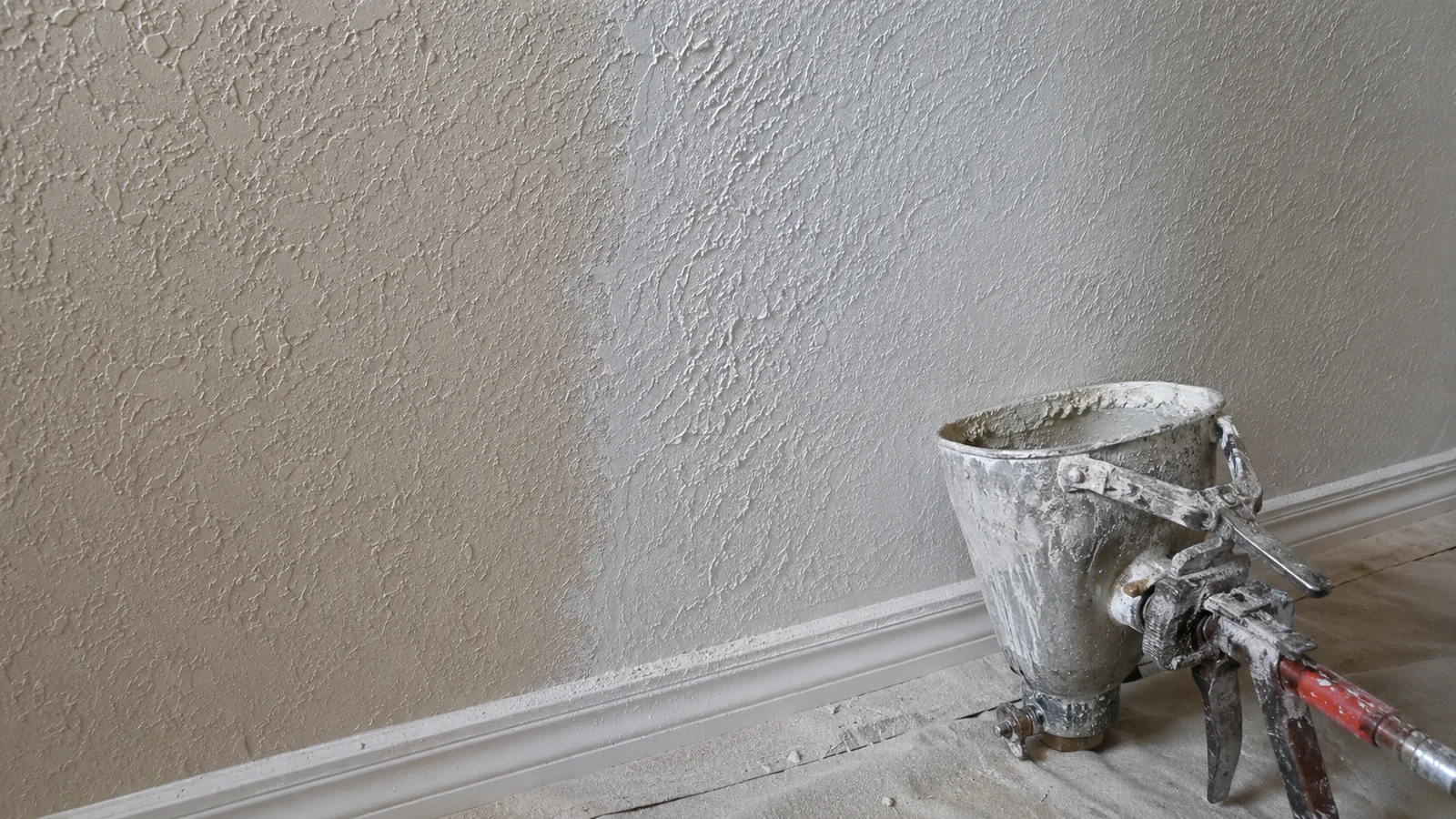
Texture matching adds roughly $1 per square foot to a drywall repair, or about $50 to $150 on a typical patch. It is also the single thing that decides whether your repair is invisible or obvious, and it is where most drywall jobs in Colorado actually fail.
Every drywall company in the Denver metro lists texture matching. All seven competitor sites we looked at name it. Not one of them explains it. So here is the explanation, including the parts that are not flattering to us.
Why does a patch still show after it has been textured?
A texture patch shows because four variables have to match and only one of them is written down anywhere. The mud has to be the same consistency, the nozzle the same size, the air pressure the same, and the distance and speed of the pass the same as whoever sprayed it originally, probably decades ago, using equipment nobody wrote down.
USG's own application guidance treats these as job-tuned rather than fixed. Their instruction for ceiling spray texture is to adjust the air spike, orifice and pressure to optimise atomisation, and notes that slight adjustments for the type and grade of aggregate may be necessary. When the manufacturer will not give you a number, that is a fair signal that there is no number to give.
There is a fifth variable that nobody can undo, and it is the one we get argued with about. Every coat of paint a wall has had since the texture went on has softened its profile slightly. A fresh patch sprayed at technically correct settings comes out sharper than forty-year-old texture beside it, because the old texture has been rounded off by five coats of paint. That is our read from doing this rather than something published, so treat it as a working theory, but it is why matching gets harder with the age of the house rather than easier.
What we can match, and what we will tell you to stop chasing
Orange peel matches well. It is a fine spatter, the variables are forgiving, and a blended edge disappears under paint in most light.
Knockdown matches well on walls and less well on ceilings, because ceilings get raking light along their whole length and walls usually do not. On a wall we blend outward past the repair by a foot or more so there is no hard edge to catch the eye. On a ceiling under a window we will sometimes recommend texturing the whole lid rather than the patch.
Skip trowel and hand-applied textures are a different job. They are trowelled, not sprayed, and matching one is a question of whether we can copy the original hand, which is honest craft rather than equipment. Sometimes yes. Sometimes the honest answer is that the room reads better fully redone.
Popcorn we will generally advise against patching above a couple of square feet. See the removal page for why.
The equipment, since it decides the result
Spray texture goes on with a hopper gun fed by a compressor, or with a dedicated texture rig like the Graco TexSpray RTX family. CGC and USG publish the pressures: orange peel wants roughly 40 psi atomising air with material feed around 20 psi, spatter and knockdown want roughly 60 psi atomising with material at about half that, and knockdown is simply spatter that gets flattened with a blade once it has tacked off.
The other number worth knowing is temperature. The manufacturer minimum is 55 degrees Fahrenheit for air, water, mix and surface, held through application and drying. That is a real constraint in an Arvada January on a garage or a basement that is not being heated, and it is why we will sometimes ask to put a heater in a room overnight before we spray it rather than just turning up and hoping.
Ruben keeps a pair of test boards in the van for this. We shoot the mix on a scrap before it goes anywhere near your wall, hold it up next to the existing texture, and adjust. That takes fifteen minutes and it is the whole difference.
Priming, which is half of the match
A perfect texture match still reads as a patch if the porosity is wrong. New compound drinks paint at a different rate than forty-year-old painted wall, so the same topcoat comes out with a different sheen over the repair. The trade name for the stripe this produces is joint banding.
CGC's guidance is to use a first-coat or pre-coat product specifically to equalise porosity variation between the board face and the finished joints. We prime the repair and the blend zone, not just the compound, for the same reason. Over an existing glossy surface the guidance is to dull it by sanding so the primer has tooth.
If you are painting yourself afterwards, this is the one bit of advice worth taking from us: prime the patch, then paint corner to corner, not patch to patch. A spot-painted repair on a wall that has faded for fifteen years will show as a rectangle even if the texture is flawless.
| Texture | Installed cost per sq ft | How it goes on | Match difficulty |
|---|---|---|---|
| Orange peel | $0.80 to $1.50 | Sprayed, roughly 40 psi atomising | Easy |
| Knockdown | $1.00 to $2.50 | Sprayed at spatter settings, then bladed flat | Moderate on walls, hard on ceilings |
| Skip trowel | $1.00 to $2.50 | Hand trowelled | Hard, it is a copy of someone's hand |
| Smooth, level 5 | $2.00 to $3.50 | Skim coat over a completed level 4 | Not a match job, it is a whole-wall job |
| Ceiling texture, general | $1.00 to $2.00 | Sprayed | Hard, raking light shows everything |
| Retexture, strip and reapply | $1.80 to $3.80 | Removal then respray | The fallback when matching is not realistic |
Questions we get asked
How much does texture matching add to a repair?
Texture matching adds about $1 per square foot, or roughly $50 to $150 on a normal patch, and Angi lists it as one of the most common hidden costs on a drywall quote at $100 to $300. We itemise it separately on ours so you can see it rather than find it.
Can you match my texture exactly?
On orange peel, usually close enough that you will not find it. On knockdown, close enough on a wall and honestly variable on a ceiling. On hand-applied texture, it depends on the pattern. We test on a board first and show you before anything goes on the wall.
What texture do I have?
Most Arvada homes are knockdown or orange peel, with popcorn on ceilings in houses built before the mid-eighties. There is a photo guide on our texture types page that will let you identify yours in about thirty seconds.
Do you paint after texturing?
We prime the repair and the blend zone as part of the job, because unprimed compound will flash through the topcoat. Finish painting we can do or you can, and if you are doing it, paint the whole wall rather than just the patch.
Related
- Ceiling Repair · Sagging, cracked or holed ceilings put back and re-textured to match.
- Popcorn Ceiling Removal · Scraped, skimmed and re-textured, with the asbestos rule explained before we quote.
- Water Damage Repair · Wet board out, framing dried and metered, then rebuilt and re-textured.
- Everywhere we work